
Fact 1
We are on average 2cm shorter when we go to bed than we were in the morning. Gravity compresses the spines discs throughout the day leaving us 2cm shorter when we go to bed.

Good spinal alignment means your head, neck and spine form a natural, neutral line while you sleep, with no section of the spine pulled up, pushed down or twisted.
Medium-firm mattresses are recommended for the best spinal alignment, and pocket sprung and hybrid mattresses tend to be the best type because they use individual springs which respond independently to different parts of your body.
A firmer mattress is not always best for your back. A surface that's too firm fails to support the neck and shoulders, and a mattress that's too soft lets the hips and shoulders sink, pulling the spine out of line.
Your sleep position plays a big part in how well your spine remains aligned. Side sleepers need more support at the shoulder and hip, back sleepers need consistent lumbar support, and front sleepers need the least of all.
A mattress supports alignment but doesn't correct a spinal condition. Persistent or severe back pain should be assessed by your GP and/or physiotherapist.
Sleep is an important time for recovery and repair from the stresses and strains of the day, but aches and pains can make it difficult to achieve quality shut eye, including those caused by improper spine alignment. Poor spinal alignment can make sleeping uncomfortable while compounding your issues.
We created this helpful guide to cover the basics of spinal alignment, which mattress types can best support you as a sleeper, how to spot whether a mattress is working for you before you commit, and what to do if you and the person you share a bed with need completely support to you.
We are on average 2cm shorter when we go to bed than we were in the morning. Gravity compresses the spines discs throughout the day leaving us 2cm shorter when we go to bed.

When we dream we enter a state called Atonia, where the skeletal muscles go into a state of paralysis to ensure we do not act out our dreams.

Relaxed, well-aligned sleep positions through the night allows the spine to recover, while tension on the spine can lead to back pain, neck pain, headaches, stiffness, and soreness.

Over 40% of our body weight lies on the hips. While laying flat, our weight is not evenly distributed, and to maintain spinal alignment your mattress needs to respond to the difference in pressure from head, to shoulders, to hips. Mattress zoning helps to maintain even weight distribution.

the shape of the spine
Your spine isn't straight. Viewed from the side it has natural curves - inward at the neck, outward across the upper back and inward again at the lower back. Good spinal alignment means those curves are held in their natural position, with nothing exaggerated, flattened or twisted.

when you lay down
When you're standing, your muscles do that work. When you lie down, your mattress takes over. That's the whole purpose of a great mattress: to hold your spine roughly in the same neutral shape it has when you're standing comfortably, while your muscles switch off and rest.

your mattress & your spine
When sleeping on the right mattress for you, your body will relax. With the wrong mattress, your muscles will spend the night bracing to hold your spine in a position your mattress isn't supporting. If you can’t sleep a full eight hours and wake up feeling tired, your mattress may be the problem.
Waking with lower back stiffness that eases once you're up and moving
Shoulder or hip ache on whichever side you sleep on
Waking up to turn over more often than you used to
Feeling like you're sleeping ‘in’ your mattress rather than ‘on’ it
Sleeping noticeably better in hotels or other beds
A visible dip or body impression in the mattress that doesn't spring back
The best mattress for spinal alignment keeps your head, neck and spine in a neutral line, supporting your body's heavier areas without letting them sink. Medium-firm pocket sprung or hybrid mattresses tend to achieve this best for most people, though the right firmness depends on your sleep position and build.
You can tell when a mattress isn’t right for your spine. Not always while you're lying on it, but certain telltale signs like waking up with a stiff lower back, an aching shoulder, or a neck twinge that takes until mid-morning to shift are signals that you may be using the wrong mattress.
All of our mattress types support good alignment: but they all differ, and some mattresses will be better suited to your spine rather than others.

1. The sleep surface. The layer that encloses the mattress for aesthetics, often with added benefits.
2. The comfort layer. A layer of gel, foam or fibres designed to improve the comfort of the mattress. Sometimes it offers other benefits such as cooling or soothing.
3. The support system. Usually made from springs or foam, the support system is responsible for weight distribution and maintaining your body’s posture through the night. It is the support system’s job to ensure a healthy posture with good spinal alignment.

The key to perfect spinal alignment is even weight distribution through zoning. Our body weight is not distributed evenly from head to toe. When laying down, over 40% of our weight is around the hips, so zoning a mattress to provide more support around the hip area helps prevent your hips from sinking in too far, improving spinal alignment.

Silentnight Mirapocket® and Miracoil® mattresses are zoned into three parts, with the middle third manufactured to be firmer as over 40% of our weight is in our hip zone when we lie flat.
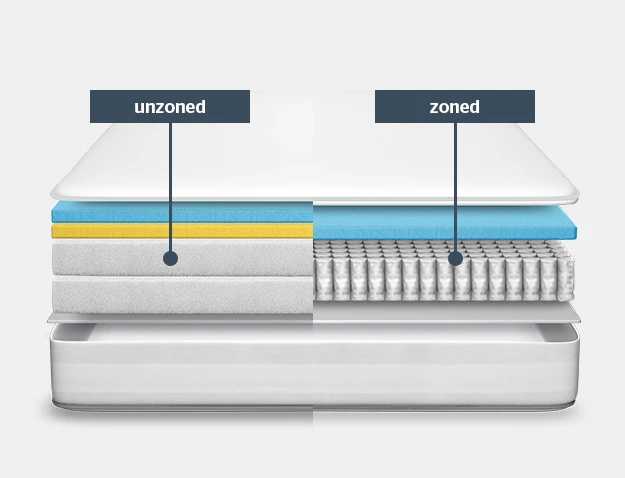
Zoned mattresses can be a good choice for improving spinal alignment and relieving lower back or hip pain, this is when a mattress contains various tensions, densities, depths or firmness areas throughout the mattress. Traditional open coil spring systems and many foam and even hybrid mattresses aren’t zoned. These types of mattresses are ideal for growing children.
For an adult, you’d want to look for a zoned mattress such as a Silentnight Mirapocket®, or Miracoil® mattress.
Firmness isn't a fixed answer, because the shape your body makes against the mattress depends on how you lie:
Side sleepers: Need the most give. Lying on your side, your shoulders and hips are the widest points of your body, and they need to sink into the mattress for your spine to stay level. A surface that's too firm leaves your waist unsupported and your spine curving sideways. Medium to medium-firm usually works best, often with a contouring comfort layer.
Back sleepers: Need consistent support through the lumbar curve, without the lower back either arching up or flattening out. A medium-firm mattress is the classic fit here, and zoned pocket springs are particularly useful because they can firm up exactly where your weight concentrates.
Front sleepers: Need the least give of all. With your torso's weight pressing down across a broad area, a soft mattress lets the stomach sink and arches the lower back - which is why front sleeping is the hardest position for alignment generally. Medium-firm to firm keeps you flatter and reduces that arch.
If you change position through the night: As most people do, look for a responsive mattress that adapts as you move, rather than one optimised for a single position. A hybrid or a responsive pocket sprung mattress handles this best.
Your build matters too: The heavier you are, the more you'll compress any given mattress, so a heavier person generally needs a firmer mattress than a lighter person to achieve the same neutral alignment. Two people can lie on the identical mattress and get different results.
Ten minutes laid on a mattress in a store cannot tell you how your spine will feel after six hours on it. Alignment problems announce themselves gradually, in the form of how you feel when you wake up over a run of nights – Silentnight’s sleep trial gives you 60 nights to decide.
Your body needs time to adjust to a new sleep surface - particularly if you're moving from something much softer or much firmer. We recommend you sleep on a new mattress for at least 28 nights before making a decision. That adjustment period tells you what you need to know: a correctly supportive mattress can feel unfamiliar for the first week or two while your body adapts.
Plenty of people want to lie on a mattress before committing, and for alignment specifically, trying a mattress in person to narrow down the firmness, then using the Silentnight sleep trial to confirm it over weeks is something we’d highly recommend. Find your nearest Silentnight retailer to test out our mattresses before committing.

A mattress with two spines sharing it can mean your mattress needs two sets of requirements. Couples rarely need the same thing, because alignment depends on variables that differ between you both:
Weight difference: The heavier partner compresses the mattress more, so a surface that aligns one person can leave the other either sinking or lying on top of it.
If you sleep in different sleep positions: A side sleeper needs give at the shoulder and hip; a front sleeper needs a flatter, firmer surface.
If you’re different heights: Lumbar support lands in a different place on a tall person than a short one.
Existing back problems: This can often mean you need different support priorities.
A pocket sprung mattress or our Silentnight Dual Firmness may be ideal for most couples. Each spring compresses independently, the mattress can respond differently under each person - giving way where the heavier partner needs it while still supporting the lighter one.
When your sleep positions differ: A hybrid is often the best compromise. The sprung core handles the structural support while the foam or gel comfort layers adapt to each person's shape independently - so a side sleeper gets the shoulder and hip relief they need without the back sleeper losing lumbar support.
Our UltraGel range is designed around exactly this: pressure relief that works in any sleeping position, which is what you need when the two of you don't share one.
Spending more typically buys better support engineering, higher-grade materials and greater durability, all of which help maintain alignment over time. Beyond the mid-range, much of the additional cost goes on comfort layers and finish rather than structural support.
Important to note: A well-fitted mid-range mattress will align your spine better than an expensive one at the wrong firmness.
You should speak to your GP or a physiotherapist before you consider a new mattress if:
Back pain has persisted for more than a few weeks without improving.
Pain radiates down one or both legs, or into the arms.
Pain wakes you in the night or is no better after getting up and moving.
Remember, we’re here to help. Check out our handy quiz below to find your sleeper type, and this can have you one step closer to the best mattress for proper spinal alignment. A comfy night’s sleep on a new mattress is just a few clicks away.