
mattress & bed size guide
What size bed and mattress should I choose, and will it fit in my home?

The world of beds and mattresses can be complicated, so we're here to keep things simple. Choosing your sleep set up is a big step towards having your best night’s rest, which is why it's important to find the perfect mattress and bed for you. That usually means it’s the right size for your room and meets your needs. Whether you're looking at single beds for your little one or a super king mattress for you and your partner, make sure you find the right size mattress to pair with a matching bed size in our mattress and bed size UK guide.
a guide to UK mattress sizes




what size is a cot bed mattress?
A cot bed mattress’ dimensions are 70cm wide by 140cm long (2’3” x 4’6”). These are specifically designed for a snug fit in a cot, ensuring a safe and comfortable sleep for little ones. Remember to take into consideration your child’s growth.
how to measure bed size
To measure a bed, you should start at the headboard and extend your tape measure to the foot of the bed. Measure the width from side to side and the length from head to foot. Below are the most common UK bed sizes, measuring in both width and length.
UK bed sizes
| width | length | |
|---|---|---|
| Single bed size | 90cm | 190cm |
| Small Double bed size | 120cm | 190cm |
| Double bed size | 135cm | 190cm |
| King size bed size | 150cm | 200cm |
| Super king bed size | 180cm | 200cm |
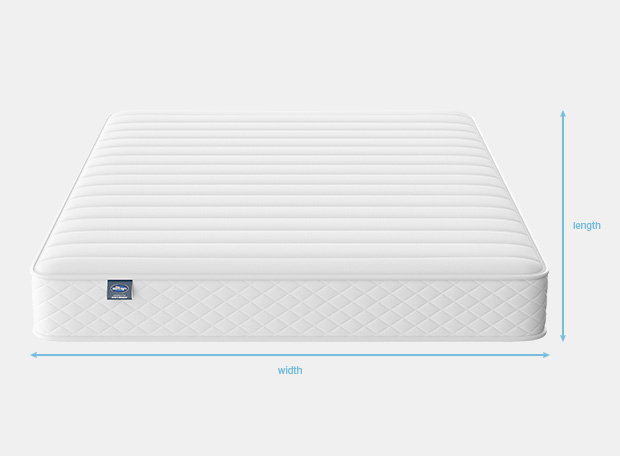
standard UK bed sizes
See below for all the different bed sizes so you can ensure the perfect fit in your home.
what size is a single bed?
A single bed size is 90cm wide x 190cm long.
what size is a small double bed?
A small double bed size is 120cm wide x 190cm long.
what size is a double bed?
A double bed size is 135cm wide x 190cm long.
what size is a king size bed?
A king size bed’s dimensions are 150cm wide x 200cm long.
what size is a super king bed?
A super king bed size is 180cm wide x 200cm long.
How bed frame styles affect total dimensions
How big your bed is all depends on its style and design, with bed frames coming in all shapes and sizes. We’ve listed the most popular bed styles below and what to consider if they’re what you’re considering.
Divan Beds: You don’t need to worry about assigning extra space to a divan bed, as they tend to match the mattress size exactly.
Bed Frames: If they’re made out of wood or metal, it’s likely they’ll protrude further than the mattress itself.
Ottoman Beds: As these hold storage within their core, which can be accessed by lifting the base, you’ll need to ensure there’s ample room around the bed to make use of this.
Upholstered Beds: If you’ve gone for a sleigh-style or a large headboard, you’ll need to ensure there’s enough space for it.
Adjustable Beds: As these can extend when they’re raised, you’ll need to make sure there’s room for movement and expansion.
Sofa Beds, Day Beds & Foldable Beds: These will naturally extend when used for sleeping, so there’ll need to be ample space to allow for this.
TV Beds: The TV will rise from the foot of the bed, meaning you’ll need to account for this in terms of space. This also includes ensuring you don’t have a low light fixture.
bed sizes and delivery
So that we can safely and efficiently deliver your bed or mattress, it’s important to ensure that your new purchase will fit in your chosen room. If you’re wondering how to choose a bed and what needs to be considered, we’ve got you covered. We’ve put together a guide on bed positions and the key measurements that need to be taken using a tape measure and optionally a protractor or angle finder, before making your purchase:

measure your room
First of all, make sure the new mattress physically fits in your bedroom. But also consider any furniture and space to move around the bed. It's important to note that while divans are usually the same width and length as the mattress plus headboard, many bed frames are slightly wider and longer. We recommend that you check all the sizes before you order.
measure your doorways
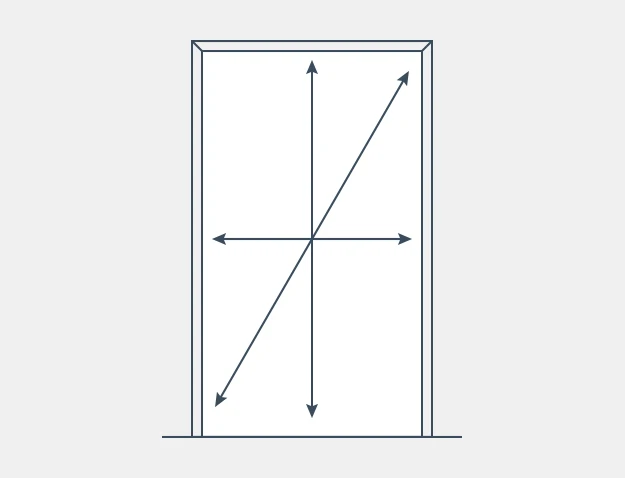
Most mattresses shouldn’t be bent, so you should always measure your front door, and any doorways between the front door and the mattresses final space to make sure it can fit through. The doorway should be higher than the mattress width. If measuring diagonally, be sure to account for the mattress depth also. To make things simple, there's always the option of a rolled up mattress.

measure your stairway
Often the tightest point of a house is the staircase. You should measure the distance to any low ceilings perpendicular (at a 90° angle) to the staircase. The clearance should be comfortably greater than the mattress width to ensure a good fit without scuffing anything. While you’re measuring for height, watch out for lamp shades too!

measure any corners
Consider any turns that your mattress will have to make. That could be a turn in the stairs, or in a hallway - often around the banister rail too. Measure against the mattress length and depth to ensure your mattress can make it round without being bent. Pro Tip: if the mattress will fit across the corner at 45°, it’ll turn all the way around just fine. This is also a good opportunity to remove any hanging pictures, mirrors etc.
frequently asked questions on bed and mattress sizes
can you fold a mattress?
Generally, no. Folding or bending a mattress will often damage the springs and comfort layers and it’ll void the warranty you hold with us - something the delivery team will not want to risk. A very small amount of give can be expected, but we recommend avoiding this at all costs.
what is the largest size mattress?
The biggest mattress size is a super king size mattress, measuring at 6 feet × 6 feet 6 inches. Our super king’s offer ample room for couples, allowing you to stretch and naturally isolating motion.
how do you measure a mattress size?
Grab a tape measure and follow these 3 simple steps:
Measure the width from one side to the other across the top of the mattress.
Measure the length from the head to the foot of the mattress.
Measure the depth (height) from the base to the top surface.
We recommend you always measure in a straight line, remove any bedding prior for accurate results, and round up to the nearest measurement.
what is the standard mattress depth?
A standard UK mattress has a depth of between 7 to 11 inches, but they can go deeper to 14 inches, depending on the bed frame used.
what heights do beds come in?
Beds vary in height depending on their design, with divan beds being higher than most styles because they offer a base and storage solutions. You’ll also find that adjustable beds are available in a range of heights, especially if they’re bespoke-made. As a general guide:
Low beds: Lower beds are sized at 30 to 45cm, from the floor to the top of the mattress.
Standard sized beds: The most common bed height is 45 to 60cm in the UK.
High beds: Bed types like divans and other luxury designs can be between 60 to 75cm.
what are EU mattress sizes?
There are differences between UK and EU mattress sizes. Here’s a quick guide:
Single | Double | King | Super King | |
|---|---|---|---|---|
UK Mattresses | 90 x 190cm (3’ x 6’3”) | 135 x 190cm (4’6” x 6’3” | 150 x 200cm (5’ x 6’6”) | 180 x 200cm (6’ x 6”6) |
EU Mattresses | 90 x 200cm (3'0" x 6'6") | 140 x 200cm (4'7" x 6'6") | 160 x 200cm (5'3" x 6'6") | 150 x 200cm (5'0" x 6'6") |
how many different mattress sizes are there in the UK?
You’ll find four standard mattress sizes in the UK, which are single, double, king and super king. But there are also other variations available depending on the retailer, including small double, queen, euro king and emperor mattresses.
Choosing the right mattress or bed size is important for a number of reasons; it ensures a good fit for your bedroom, ample space for you or you and a partner (or pet), and it allows you to sleep comfortably with a sleep set-up big enough for your sleep style – whether you stretch out or toss and turn.